by Margherita Borsoi
Analog’ documents, such as archival papers, preserve an intrinsic vitality and a revolutionary potential that often escape a superficial glance. The starting point is precisely this restlessness of the papers, their tendency to exceed the function of a simple documentary support. These are complex materials, both for the content they convey and for the uses they make possible, and it is precisely for this reason that they can prove destabilizing. The fragility of the media intertwines with the delicacy of the contents, their spatial displacement, the conditions of their preservation and, above all, the interpretations that arise from them.
From here, an inevitable reflection opened up on the very meaning of the archive. Approaching a documentary collection as if it were a repository of truth is a misleading operation: ‘archives are not true; at most, they can be authentic.’ Every archive is the result of a choice, of a process of selection and exclusion that determines what is deemed worthy of preservation and what can be allowed to disappear. It is no coincidence that archivio derives from archè, origin, ordering principle. This character emerges clearly in the processes of centralizing the Kingdom’s documentary collections in post‑unification Italy, where the State archive takes the form of a hierarchical device built around an imposed order.
Yet it is precisely this model that reveals its limits when the focus shifts to the world of social movements.
Movements are fully immersed in History, but at the same time they traverse it conflictually, exceeding its ordering devices. Alongside the archè of the ‘strong’ archive, ‘where order is given,’ there also takes shape the anarchè, ‘the place of constituted disorder’: a space in which the archive does not serve to fix a narrative, but to make legible new social relations inscribed in the succession of documents.
It is in this context that the question of Memory becomes central.
The emergence of movement archives calls into question both the individual and collective dimensions of remembering.
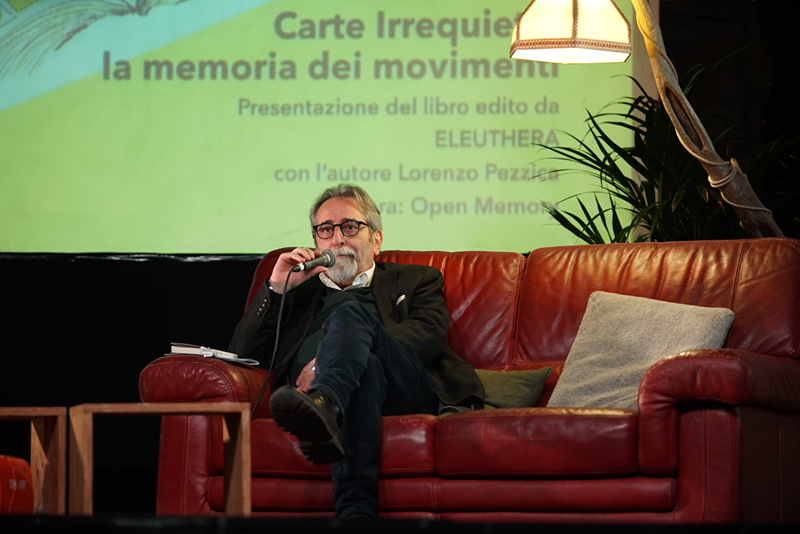
One of the clearest examples of a “movement archive,” repeatedly evoked during the discussion, is Open Memory, the research and documentation center that for nearly four years has been carrying out work on memory in the historic headquarters of Radio Sherwood in Padua.
Jacopo Pozzoni, who moderates the discussion, brings into dialogue two radically different approaches: on one side, Toni Negri’s praise of the absence of Memory; on the other, Abdullah Öcalan’s revolutionary theory, rooted in decades of Kurdish history and resistance. The tension that emerges concerns the very possibility of a militant archive that continues to act politically in the present, without turning into a museum device or a pacified collection of recollections.
The concrete practice of preservation further clarifies this tension. As Pezzica notes, the documentation produced by movements arises within fluid, horizontal, and often underground contexts that recover what is systematically excluded from institutional memory. These papers are not conceived for future cataloguing, but as immediate tools of action and struggle. Precisely for this reason, the centralization typical of state archives proves incompatible with their nature. Indeed, it is often thanks to dispersion that these materials have survived: faced with the risk of raids and repression, the alternatives were destruction or dissemination among “nomadic subjects,” the militants.
Only years later were those same documents drawn together by a new centripetal force, generated by the desire to recompose a part of the history of the movements. The creation of grassroots archives has thus contributed to building a collective Memory that does not merely preserve the past, but keeps it open, conflictual, still capable of interrogating the present.
This relational character of the papers becomes even more evident when contrasted with digital archiving practices. The issue is not the enormous quantity of information poured into databases, nor the ability to retrieve individual data through increasingly sophisticated search filters. What is lost is rather the perception of the overall network in which documents are embedded—their relational materiality. It is precisely this connection among the papers that constitutes the vital part of the archive and guarantees its authenticity.
The archive, Pezzica reminds us, is not a heap of data but a human factor.
In the case of movements, it is the performative trace of a struggle that truly existed.
The historical archive of Leoncavallo (the occupied social center in Milan) offers an emblematic example of these contradictions. The Milan social center, evicted last August, held documentation spanning fifty years of the history of left‑wing and antagonistic movements in Italy. Paradoxically, that heritage is now recognized and protected by the State itself—the same State responsible for closing the space and now tasked with ensuring its transfer and definitive placement.
The debate on how to take responsibility for archival collections that require space, resources, expertise, and protection thus remains open. A debate that stays alive, unresolved, and traversed by conflict—just like the restless papers at the heart of the discussion.